Don’t Fall for the Influencer Trap in Aesthetic Surgery
The Influencer Problem in Healthcare
Social media has fundamentally changed the way people obtain information about healthcare. In the past, patients would primarily consult physicians, family members, friends, or established medical sources before making a decision about surgery. Today, an entirely different source of influence has emerged: the social media influencer.
This transformation is particularly visible in aesthetic medicine and cosmetic surgery. Rhinoplasty, breast surgery, liposuction, hair transplantation, dental aesthetics and a wide range of minimally invasive procedures are now routinely presented through Instagram, TikTok, YouTube and other social media platforms.
There is nothing inherently wrong with sharing a personal medical experience. The problem begins when personal experience becomes a commercial instrument and when popularity is mistaken for medical expertise.
The influencer problem in aesthetic surgery is therefore not simply a social media problem. It is increasingly a patient safety, medical ethics and informed consent problem.
The Rising Inflation of Influencers
There was a time when becoming publicly influential required years of professional work, journalism, entertainment, scientific achievement or some other recognizable expertise.
Social media has radically changed this.
Today, almost anyone with a sufficiently large audience can become an influencer. The number of people presenting themselves as authorities on beauty, health, aesthetics and lifestyle has increased dramatically.
This creates what might be called an inflation of influence.
When everyone is an influencer, influence itself becomes less meaningful.
More importantly, follower count has gradually become confused with competence.
A person may have hundreds of thousands of followers and have absolutely no medical education, surgical training or scientific understanding. Yet that same person can influence thousands of people regarding which surgeon they should choose, which procedure they should undergo, or which medical treatment they should believe is superior.
Popularity is measurable.
Medical competence is not.
And these two characteristics should never be treated as equivalent.
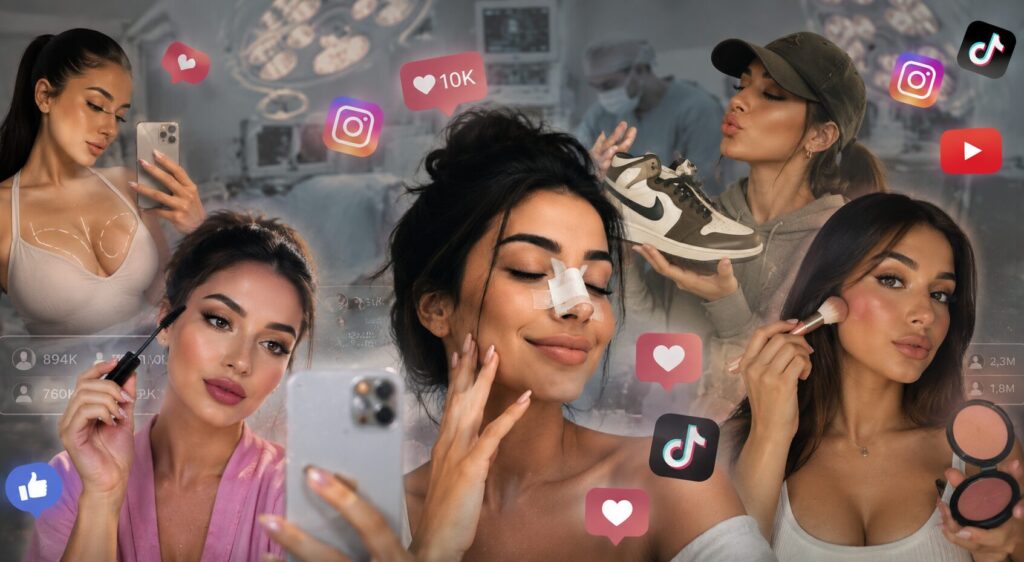
Every Neighborhood Now Has an Influencer
The phenomenon has become so widespread that almost every social circle, city and professional environment now has its own influencer.
There are major international influencers, national celebrities, local influencers, micro influencers and even individuals whose influence exists primarily within a particular social or professional community.
This fragmentation makes the problem more difficult to recognize.
A person does not need millions of followers to influence healthcare decisions. An individual with 20,000 highly engaged followers may have considerably more commercial value than someone with a much larger but less targeted audience.
In aesthetic surgery, this creates an unusual form of authority.
The influencer does not necessarily need to say:
“Dr. X is the best surgeon.”
Sometimes the message is much more subtle.
“I had my surgery here.”
“I chose this doctor.”
“I am so happy with my nose.”
“This clinic was amazing.”
To a potential patient, these statements can function as a recommendation even when no explicit medical claim is made.
The audience may then interpret the influencer’s personal experience as evidence of medical quality.
But one patient’s experience is not a clinical trial.
One successful operation does not establish surgical superiority.
And one attractive result does not establish that a surgeon is the right surgeon for every patient.
The Demand for a Free Lifestyle and Free Medical Services
One of the most problematic aspects of influencer culture is the normalization of receiving goods and services without paying for them.
Hotels, restaurants, airlines, clothing brands, beauty companies and cosmetic clinics may offer influencers free or heavily discounted services in exchange for exposure.
In aesthetic medicine, however, the situation is fundamentally different.
A hotel room is not a surgical procedure.
A complimentary meal does not carry the same medical risks as an operation.
A cosmetic surgery is an irreversible or partially irreversible medical intervention that can involve anesthesia, bleeding, infection, scarring, functional impairment, revision surgery and other complications.
Nevertheless, the commercial relationship can sometimes be presented as if the influencer simply “discovered” an excellent surgeon and decided to share the experience with followers.
This creates a serious conflict of interest.
The influencer may receive a free operation, a substantial discount, accommodation, transportation, additional aesthetic procedures or other benefits.
In return, the medical provider receives something potentially much more valuable: access to the influencer’s audience.
The transaction is therefore not necessarily a spontaneous medical recommendation.
It can be advertising disguised as personal experience.
This distinction matters.
Regulators such as the U.S. Federal Trade Commission explicitly recognize that free or discounted products and services can constitute a material connection between an influencer and a business and that such relationships should be clearly disclosed when relevant to an endorsement.
The Part You Do Not See: Complications and Negative Outcomes
Perhaps the most serious problem is not what influencers show.
It is what they do not show.
A successful aesthetic procedure can generate months or even years of attractive content.
The consultation.
The journey.
The hospital.
The postoperative photographs.
The swelling.
The final result.
The celebration.
But what happens when the result is not perfect?
What happens when there is prolonged swelling?
What happens when breathing deteriorates?
What happens when asymmetry develops?
What happens when a scar becomes problematic?
What happens when a patient requires revision surgery?
What happens when the surgeon and patient disagree about the result?
What happens when the influencer is dissatisfied?
These outcomes are much less likely to become attractive social media content.
This creates a fundamental selection bias.
The audience sees the successful, aesthetically pleasing and commercially useful cases.
The unsuccessful or complicated cases may disappear from the narrative.
Consequently, followers can develop an artificially optimistic perception of cosmetic surgery.
They may begin to believe that aesthetic surgery is predictable, simple, quick and almost universally successful.
It is none of these things.
Every surgical procedure has uncertainty.
Every patient has individual anatomy.
Every operation has potential complications.
And no responsible surgeon can guarantee a particular aesthetic result.
When Advertising Becomes Medical Misinformation
The problem becomes considerably more serious when influencers move beyond describing their personal experience and begin giving medical advice.
Statements such as:
“This technique is safer.”
“This surgeon never causes complications.”
“This procedure has no downtime.”
“You will definitely get this result.”
“This is the best technique.”
“This surgeon is the best.”
can easily transform an individual experience into an apparently universal medical claim.
The scientific problem is obvious.
An influencer generally does not have access to the data required to make such conclusions.
They do not know the surgeon’s complication rate.
They do not know the revision rate.
They do not know the long term functional outcomes.
They do not know the denominator.
They do not know how many patients experienced complications but never appeared on social media.
They know what happened to themselves.
That is all.
Systematic reviews have already demonstrated that social media can influence body image and motivations toward cosmetic surgery, while broader research has identified health misinformation as a significant social media problem.
The danger therefore lies not only in false information.
It also lies in incomplete information presented with excessive confidence.
The Patient Is Not Choosing a Restaurant
One of the most important distinctions that society needs to understand is that choosing a surgeon is fundamentally different from choosing a restaurant, hotel or fashion brand.
A restaurant recommendation is largely reversible.
You can dislike the food and never return.
A surgical decision is different.
The patient’s anatomy, expectations, medical history, psychological profile, functional complaints, skin characteristics, previous operations and long term goals all influence the appropriate treatment.
Two people can undergo exactly the same procedure with completely different indications and completely different outcomes.
Therefore, the question should not be:
“Which surgeon did this influencer choose?”
The correct question is:
“Which surgeon is appropriate for me?”
That requires a medical evaluation.
The Most Dangerous Shortcut
One of the most dangerous shortcuts in modern aesthetic medicine is this:
“The influencer had surgery there, therefore I should have surgery there too.”
This is not a medical decision.
It is a marketing driven decision.
The influencer may have completely different anatomy.
They may have different expectations.
They may have received a different procedure.
They may have negotiated a different treatment package.
They may have received the procedure for free.
They may have received additional treatments that were never mentioned.
They may have had an unusually favorable result.
Or, critically, they may simply be presenting the favorable part of the story.
The patient’s decision should therefore never be based primarily on the identity of the people appearing in a clinic’s social media feed.
A surgeon should be evaluated through education, training, specialization, experience, clinical judgment, communication, surgical planning, realistic expectations, complication management and long term follow up.
Followers are not a surgical credential.
Views are not a complication rate.
Likes are not clinical evidence.
And influencer popularity is not medical expertise.
The Ethical Responsibility of Physicians
This problem is not solely the responsibility of influencers.
Physicians and clinics also have a responsibility.
Healthcare professionals should be extremely cautious when commercial relationships with influencers are involved.
A physician who provides a free procedure in exchange for promotional exposure is entering a fundamentally different relationship from that of a physician treating an ordinary patient.
Transparency becomes essential.
If an influencer received a free or discounted medical service, that relationship should not be hidden behind vague expressions such as “collaboration” or “thank you.”
The audience deserves to know whether the person recommending a surgeon actually paid for the treatment or received it as part of a commercial arrangement.
The distinction is especially important in healthcare because the audience is not merely purchasing a product.
They may be making a decision involving their body, their health and sometimes their psychological well being.
The Real Problem Is the Incentive Structure
The influencer economy creates a simple incentive structure.
The influencer wants attention.
The clinic wants visibility.
The audience wants information.
But these three interests do not necessarily align.
The influencer benefits from presenting an attractive success story.
The clinic benefits from presenting positive outcomes.
The audience, however, needs something different.
The audience needs balanced information.
They need to understand indications, alternatives, risks, complications, limitations, uncertainty and long term outcomes.
This is precisely where commercial incentives can distort medical communication.
When financial or material incentives are present, the audience must know about them.
Otherwise, what appears to be an independent patient recommendation may actually be a form of advertising.
The Patient Must Take Back the Decision
Aesthetic surgery should begin with a medical consultation, not an Instagram post.
Social media can be useful for understanding a surgeon’s philosophy, observing examples of their work and learning about different procedures.
But it should be the beginning of research, not the end of it.
Patients should ask:
Who is performing my surgery?
What is their medical specialty?
How much experience do they have with this specific procedure?
What are the realistic benefits?
What are the risks?
What are the possible complications?
What happens if I am dissatisfied?
What happens if a complication occurs?
What is the long term follow up?
And most importantly:
Would I still choose this surgeon if the influencer had never mentioned them?
If the answer is no, the decision deserves to be reconsidered.
Final Note: Do Not Choose Your Surgeon Through an Influencer
Remember this:
Influencers often receive free or heavily discounted products and services precisely because they provide promotional value to businesses.
That does not automatically make every influencer dishonest.
It does, however, mean that the relationship must be recognized for what it is.
An influencer’s personal experience can be interesting.
It can even be useful.
But it should never replace professional medical evaluation.
Choosing a surgeon because an influencer had “this surgery with this doctor” may be one of the most dangerous shortcuts in modern aesthetic medicine.
The influencer’s face is not your face.
Their anatomy is not your anatomy.
Their expectations are not your expectations.
Their agreement with the clinic may not be the same as yours.
And their outcome cannot predict yours.
In aesthetic surgery, the most important question is not:
“Who did the influencer choose?”
It is:
“Who is the right surgeon for me?”
That decision should be made through medical knowledge, clinical judgment, transparency and evidence, not through follower counts, sponsored content or the illusion of a perfect social media success story.