


You land on a Sunday evening, a week after surgery abroad, and your car is in the airport car park. Can you drive it home? For the first day or two the answer is no. The NHS says not to drive for at least 24 hours after a general anaesthetic (the medicine that keeps you asleep during the operation), and one hospital leaflet says 48. After that, most hospital leaflets say nothing, and your surgeon sets the date.
Key takeaways
- The NHS says not to drive for at least 24 hours after a general anaesthetic, a July 2026 hospital leaflet says to avoid driving for the first 24 to 48 hours, and Coventry and Warwickshire says you may drive again 48 hours after the operation.
- Only 2 of the 9 UK leaflets on nasal surgery we read give any driving rule; the other 7 are silent, so the date after day 2 is a question for your surgeon.
- GOV.UK says it is illegal to drive if you are unfit because of a legal medicine, which includes prescription and over-the-counter ones.
- On a surgery trip the rule decides who collects you from the hospital, who takes you to the splint visit and who drives you home from your own airport.
Whether you are fit to drive is for a doctor who has seen you. This guide shows what the published sources say and where the gaps are, so you can plan the rides before you book.
When can you drive after rhinoplasty?
Not on the day of the operation, and not the next day. The sources that give a figure agree on 24 to 48 hours, and that is all the nine leaflets and the NHS page we read say:
| Source | What it says about driving |
|---|---|
| NHS, general anaesthetic (reviewed 29 November 2024) | Do not drive or ride a bike for at least 24 hours |
| NHS leaflet hosted at pah.nhs.uk, After Nasal Surgery (July 2026) | Avoid driving for the first 24 to 48 hours |
| Coventry and Warwickshire (UHCW), Discharge advice after rhinoplasty | You may resume driving 48 hours after your operation |
| Seven other UK leaflets on nasal or septal surgery (Hull, Cambridge, Royal Berkshire, Bath, West Suffolk, Aneurin Bevan, Gloucestershire) | No driving rule |
Rhinoplasty is usually done under general anaesthetic, so the NHS anaesthetic page applies to most patients. If yours is done under local anaesthetic with sedation, ask which rule your clinic uses.
Two things follow. A figure of 48 hours is the longest in the sources we read, and it counts from the operation, not from landing back home. And a leaflet that says nothing has not said yes.
Why do the first 24 to 48 hours matter?
The anaesthetic outlasts the feeling of being awake. The NHS says its effects can last around 24 hours, and the July 2026 leaflet says a general anaesthetic can affect your memory, concentration and reaction times for up to 24 to 48 hours.
The same NHS page lists what else to skip for at least 24 hours:
- Riding a bike
- Cooking or using machinery
- Looking after children or other people on your own
- Smoking and alcohol
- Making important decisions
It adds a warning about posting on social media, because you may not be thinking clearly. The leaflet asks for a responsible adult to stay with you for the first 24 hours if you go home the same day. The general anaesthesia guide covers what the anaesthetic involves.
Does pain relief change the answer?
It can. GOV.UK says it is illegal to drive if you are unfit to do so because of legal or illegal drugs, and that legal drugs include prescription and over-the-counter medicines. For England, Scotland and Wales it adds that driving with legal drugs in your body is an offence if they impair your driving. It tells you to talk to your doctor, pharmacist or healthcare professional if you are unsure.
The leaflets mostly name paracetamol. The Royal Berkshire leaflet also names co-codamol, a combination painkiller, and says to seek advice from your pharmacist. GOV.UK lists some named prescription drugs, including diazepam and morphine, that you should discuss with your doctor before driving. Anything your clinic prescribes for the trip is worth checking against that page, with the pharmacist who gives it to you.
Rules differ from country to country. GOV.UK covers Britain; readers in the US, Canada or elsewhere should check their own state or national rules.
Does swelling or the splint matter for driving?
The sources do not link them. Cambridge says your nose and eyes will be bruised and swollen for a few weeks, and Bath says bruising around the eyes usually settles within 10 days (see time off work after rhinoplasty for the full comparison). None of the leaflets says whether that affects your view of the road or whether a splint is a problem in a car.
That makes it a plain question for your surgeon at the last check: can I drive, and if not yet, when?
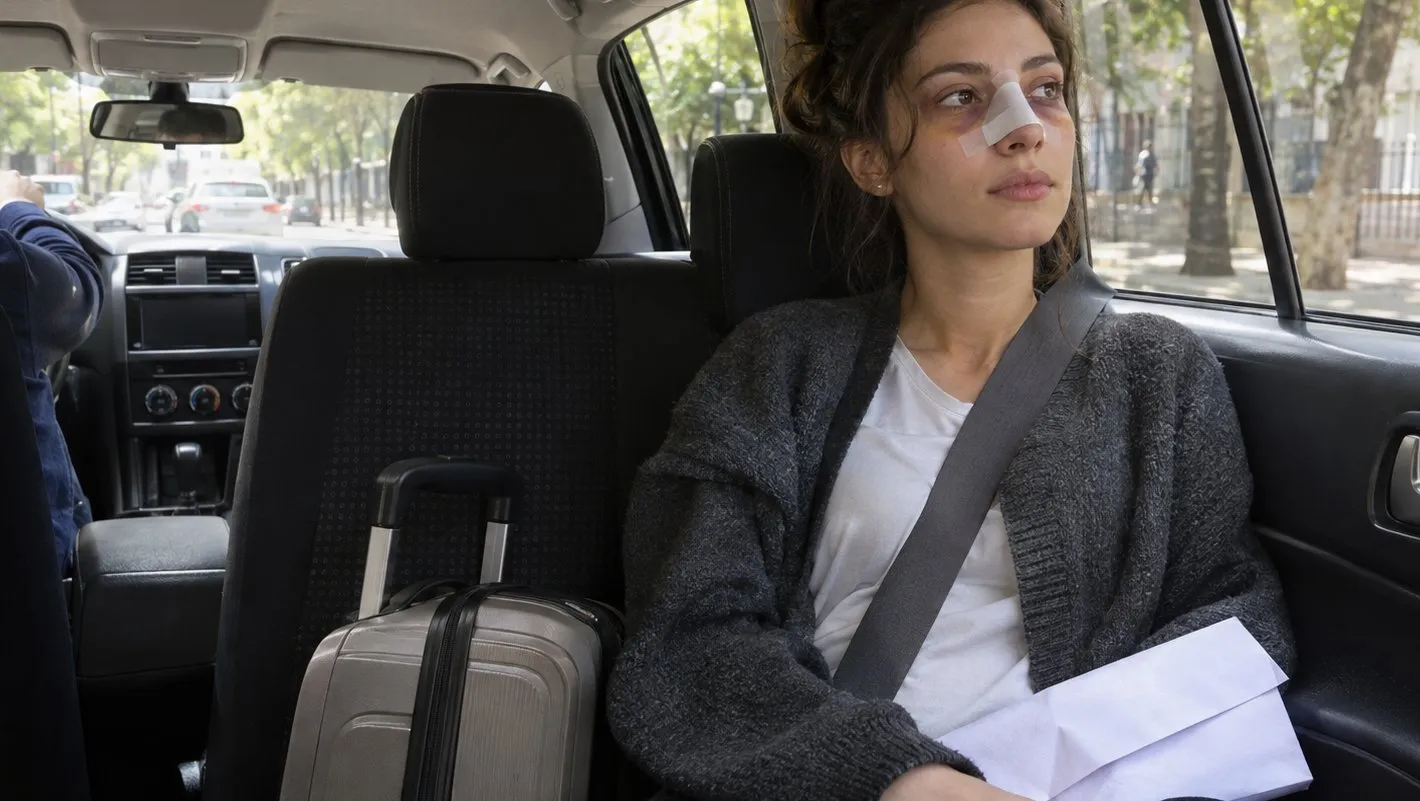
How do you get around on a surgery trip?
A trip splits the 48-hour rule into five separate rides. Each one needs a name next to it before you fly:
| Moment | What the sources say | What to settle |
|---|---|---|
| Arrival, the day before surgery | Nothing restricts driving yet | A hire car would sit unused for the first days; ask what the transfers cover instead |
| Leaving the hospital after surgery | NHS: someone needs to collect you by car or taxi; the July 2026 leaflet asks for an adult with you for 24 hours | Who rides with you, and whether the transfer to your hotel is on the quote |
| Days 1 to 2 | No driving, per the sources above | Transfers for every clinic visit, not only the airport runs |
| Splint removal visit | Cambridge takes the splint off after one week; in common practice in Turkey it is day 7 (editorial note, October 2026) | How you get from the hotel to the clinic that day |
| Flight home, then the drive from the airport | UHCW gives 48 hours; the other leaflets are silent | Whether someone meets you at arrivals |
Our flying after rhinoplasty guide covers the earliest flight date, and the guide to the trip home covers records, follow-up and bags. For what a package should list as transfers, see all-inclusive surgery packages in Turkey: the Turkish regulation asks an authorized intermediary to provide transport and transfers through licensed travel agencies and to give you an itemized breakdown of those charges.
By day 7 you are well past the 48 hours in every source, so the question at the splint visit is not whether the rule has run out. It is whether you personally are ready, and that is the surgeon’s call. Asking costs one sentence.
What should you ask before you book?
- Is general anaesthetic or sedation planned, and when can I drive after it?
- Is the transfer from the hospital to my hotel, and to every check-up, on the written quote?
- Who stays with me for the first 24 hours?
- Can I drive home from the airport when I land, or should someone meet me?
- Does anything I am prescribed for the trip carry a driving warning? (Ask the pharmacist as well.)
- If I hire a car or drive my own, does my insurance policy say anything about driving after surgery? (Read the policy wording.)
Put the answers in writing with the rest of the itinerary. The pre-surgery checklist has the other items to settle before you travel.
Sources
- NHS, General anaesthetic, last reviewed 29 November 2024: effects last around 24 hours; things to avoid for at least 24 hours; going home by car or taxi.
- NHS leaflet hosted at pah.nhs.uk, After Nasal Surgery, July 2026: avoid driving for 24 to 48 hours; adult with you for 24 hours.
- University Hospitals Coventry and Warwickshire NHS Trust, Discharge advice after rhinoplasty: driving after 48 hours.
- GOV.UK, Drugs and driving: the law: driving while unfit because of legal or illegal drugs; named prescription drugs.
- Royal Berkshire NHS Foundation Trust, Advice following nasal surgery: paracetamol or co-codamol, pharmacist advice.
- Cambridge University Hospitals, Information after septorhinoplasty: splint off after one week; bruising and swelling for a few weeks.
- Leaflets checked and silent on driving: Hull, Bath, West Suffolk, Aneurin Bevan, Gloucestershire.


