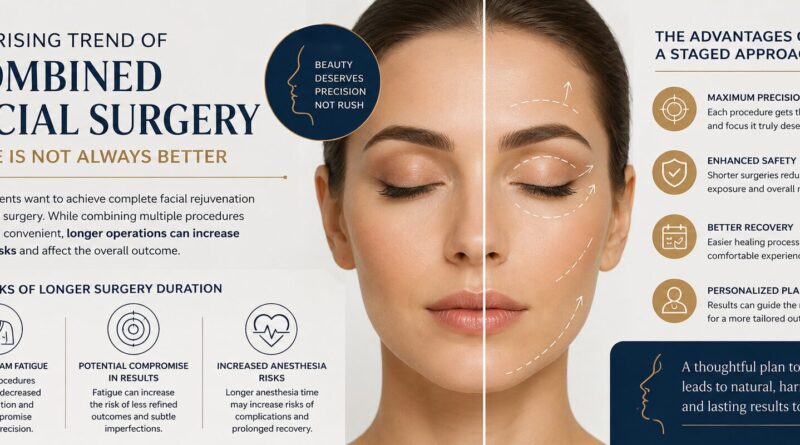
The Rising Trend of Combined Facial Aesthetic Surgery: Is More Always Better?
In recent years, the demand for facial aesthetic surgery has increased dramatically across the world. Advances in surgical techniques, anesthesia safety, and patient awareness have encouraged many individuals to seek comprehensive facial rejuvenation rather than isolated procedures. As a result, combined facial aesthetic surgeries performed during a single operative session have become increasingly popular. Patients frequently request multiple procedures such as rhinoplasty, facelift, neck lift, eyelid surgery, brow lift, chin augmentation, facial fat grafting, and lip enhancement under the same anesthesia with the goal of achieving a complete transformation while minimizing recovery time.
At first glance, combining several procedures into a single operation appears highly attractive. Patients often appreciate the convenience of undergoing one anesthesia session, experiencing a single recovery period, and potentially reducing overall treatment costs. However, despite these advantages, the growing trend toward extensive combined facial surgery raises important questions regarding patient safety, surgical precision, and long term outcomes.
Why Combined Facial Procedures Are Becoming More Common
Modern aesthetic patients increasingly seek comprehensive facial harmony rather than correction of a single anatomical feature. Social media, digital photography, and greater awareness of facial proportions have shifted attention toward global facial balance. For example, a patient undergoing rhinoplasty may also desire chin augmentation to improve profile aesthetics. Similarly, individuals considering a facelift may simultaneously request eyelid surgery and fat transfer to address multiple signs of facial aging.
The desire to maximize results in a single treatment episode has encouraged surgeons and patients alike to consider extensive operative plans. In carefully selected cases, combining procedures can indeed be safe and effective. Nevertheless, the assumption that more procedures automatically lead to better outcomes deserves careful examination.
The Hidden Challenge of Prolonged Surgical Duration
One of the most important factors often overlooked by patients is total operative time. Every additional procedure extends surgery duration, increasing physical and cognitive demands on the entire surgical team.
Facial aesthetic surgery is a discipline that requires exceptional attention to detail. Millimeter level adjustments can significantly influence the final aesthetic result. Whether sculpting nasal cartilage, positioning facial tissues during a facelift, or creating eyelid symmetry, success depends on consistent concentration and precision throughout the operation.
As surgery duration increases, natural human fatigue becomes an unavoidable factor. Even highly experienced surgeons, anesthesiologists, nurses, and operating room personnel may experience reduced physical stamina and mental sharpness after many consecutive hours of intense work. While professionalism and expertise remain essential safeguards, prolonged procedures inevitably place greater demands on the surgical team.
Surgical Fatigue and Its Impact on Precision
Facial aesthetic surgery differs from many other surgical specialties because outcomes are judged not only by safety but also by aesthetic perfection. Patients seek natural, harmonious, and highly refined results.
Extended operations may challenge the ability to maintain the same level of meticulous attention from the first hour of surgery to the final hour. The risk is not necessarily major complications but rather subtle compromises in surgical refinement. Small details that contribute to exceptional outcomes may become more difficult to optimize during very lengthy procedures.
For this reason, many experienced facial plastic surgeons advocate prioritizing quality over quantity. Rather than attempting to perform every desired procedure during a single session, carefully staged operations may allow each intervention to receive the full attention and precision it deserves.
Anesthesia Considerations During Long Procedures
Another important consideration is anesthesia exposure. Modern anesthesia is remarkably safe when administered by qualified professionals, yet the duration of anesthesia remains an important factor in perioperative risk assessment.
Longer procedures are generally associated with increased physiological stress on the body. Extended anesthesia time may contribute to higher risks of postoperative nausea, delayed recovery, fluid balance challenges, thromboembolic events, and other anesthesia related concerns, particularly in older patients or individuals with underlying medical conditions.
While many patients tolerate prolonged anesthesia without significant problems, reducing unnecessary operative duration whenever possible remains a fundamental principle of patient safety.
Recovery Can Become More Complex
Patients often assume that combining procedures will simplify recovery because everything is completed at once. In reality, recovery following extensive facial surgery can become more demanding.
Swelling, bruising, discomfort, and healing responses from multiple anatomical regions occur simultaneously. This can make postoperative management more complex and may occasionally prolong the overall recovery experience. Furthermore, if revisions or adjustments become necessary, addressing them can be more challenging when numerous procedures have been performed during the same operation.
Staged procedures allow both the surgeon and the patient to evaluate healing and outcomes progressively before proceeding to the next step.
The Advantages of a Staged Surgical Approach
A staged approach does not mean avoiding comprehensive facial rejuvenation. Rather, it involves dividing treatment into carefully planned phases that prioritize safety and surgical excellence.
By limiting operative duration during each session, surgeons can maintain peak concentration and performance. Patients may benefit from reduced anesthesia exposure, more predictable healing, and clearer assessment of each procedure’s individual contribution to facial aesthetics.
In many cases, staged surgery allows treatment plans to evolve based on postoperative results. Changes achieved by one procedure may influence the necessity, extent, or timing of additional interventions.
Individualized Planning Is Essential
There is no universal rule that applies to every patient. Some individuals may safely undergo multiple facial procedures during a single operation with excellent outcomes. Others may benefit significantly from dividing treatment into separate stages.
The decision should be based on patient health, age, surgical complexity, anticipated operative time, recovery expectations, and the surgeon’s philosophy regarding quality and safety. Comprehensive consultation and realistic planning remain the foundation of successful facial aesthetic surgery.
Conclusion
The increasing popularity of combined facial aesthetic surgery reflects modern patients’ desire for comprehensive facial enhancement and convenience. While performing multiple procedures during a single anesthesia session can offer certain advantages, prolonged surgical duration introduces important considerations including surgical team fatigue, potential compromises in aesthetic precision, increased anesthesia exposure, and more complex recovery.
For many patients, a carefully staged approach may provide the safest path toward achieving optimal aesthetic outcomes without sacrificing attention to detail. In facial aesthetic surgery, excellence is often achieved not by doing more at once, but by giving each procedure the time, focus, and precision it deserves.
This educational article was prepared with contributions and insights inspired by the clinical philosophy of some surgeons, who emphasizes patient safety, meticulous surgical planning, and individualized treatment strategies to achieve natural and refined facial aesthetic outcomes.